Acinora
the frozen moon
phyripedia


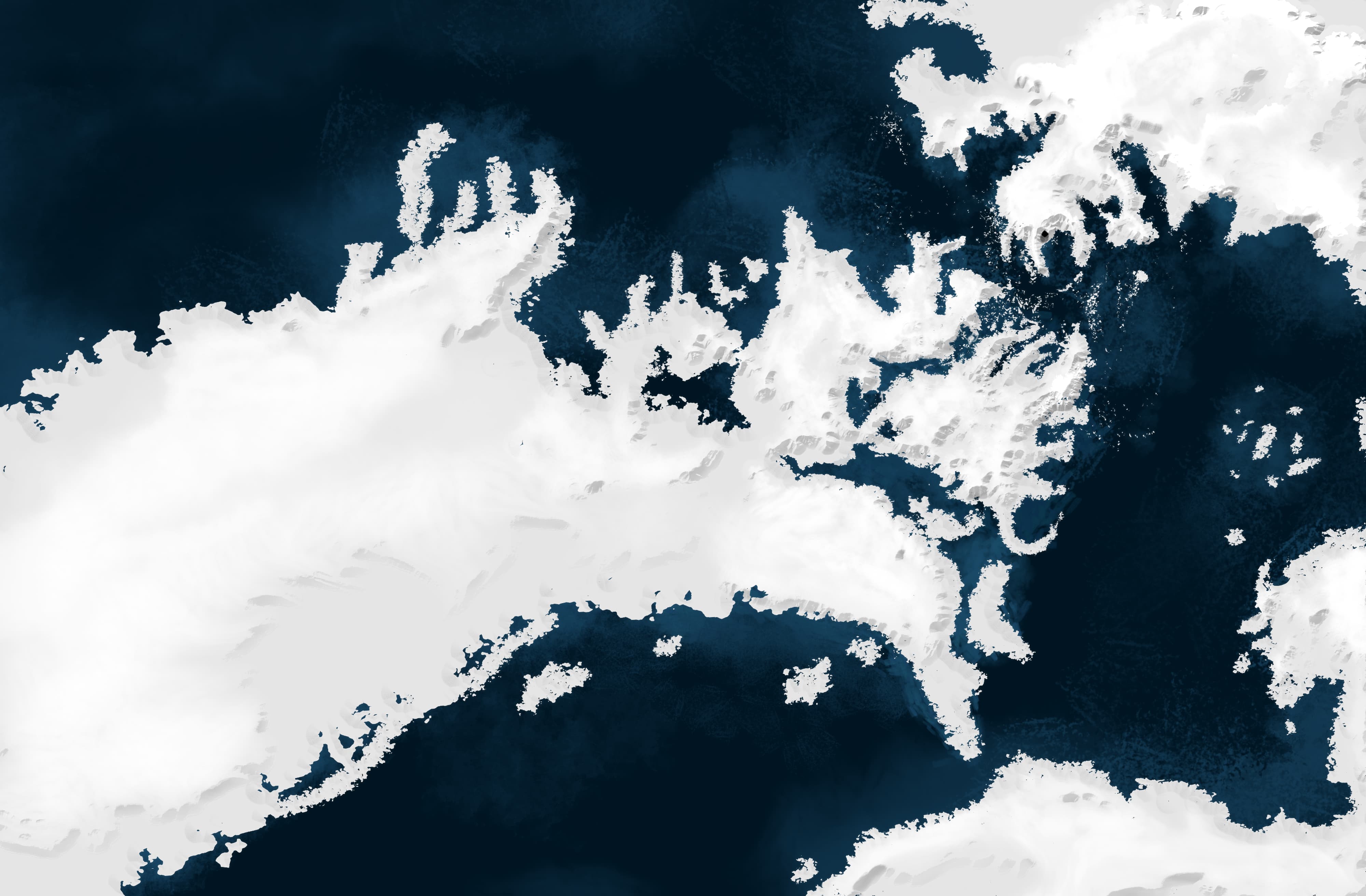
Acinora (/æk ɪn ˈnɔːrə/) is the moon of the gas giant Trej, comprised of mostly ice. However, there are small pockets of soil which exist on its crust. Covered on its surface at various locations are megastructures nicknamed Arches, the purpose of which are mostly unknown by the Norians. 1
After seven nights of travelling, we reached the peak of Mount Akisoro. Our life-support was failing. We had already lost several people from our municipality, and even after the destruction of the impact, it hurt. My son had fallen ill, likely from the cold. My mind was reeling at images of him being buried in the snow like the others. We had thought that we had lost it all. But a woman from our group saw it, beyond the storm—peeking from the silhouette of that majestic Arch. Our home was still here.
— Upon the discovery of the wreckage by the Fifteenth Arch.
Geography & Geology
Acinora is characterized by vast, complex mountain ranges and valleys that give the surface cracked, raked appearance. 2 Four major regions define the geological and geographical structures of Acinora: Frostcolumn Vents, Fracture Events, The Subsurface Unilateral Ocean, and Lattice Cryoravines.
Frostcolumn Vents
Frostcolumn Vents are violent geographical features which are known for blasting icy debris upwards. A single vent is capable of blasting superheated water out of the SUO and into the atmosphere, where it either turns to steam, snow, or in the case of large or grouped vents, lireks high into space.
Fracture Events
Fracture Events are a phenomena in which the curst continents of Acinora shift, resulting in violent tremors that fracture the surface. Fracture Events are much more common near Frostcolumn Vents. Although most fracture events are weak, only resulting in in the ground shaking or shifting, larger Fracture Events can tear the surface, leading the formation of new Frostcolumn Vents.
Subsurface Unilateral Ocean (The SUO)
Formally called the SUO, the Subsurface Unilateral Ocean is a global ocean that spans the entire underground of Acinora. The SUO varies in temperature, although near Frostcolumn Vents, its temperature reaches much above boiling.
The SUO is barely researched due to its inaccessibility.
Lattice Cryoravines
Due to Acinora’s harsh and unpredictable weather, travel is difficult and dangerous on the surface. Lattice Cryoravines serve as the primary route for a safer style of travel. Ranging from one to three lireks, (~1.5 to 4.5 mi). The canyons are dark, little light from Treo or Trej reaching the base. Temperatures here are often warmer, or a lot warmer, than the surface temperature, due to the close proximity to the SUO. However, the ravines are still dangerous. Fracture Events can rupture the thinning layers of ice, breaking the ground, especially in the case of a Fracture Event.
Structures
The Arches
Main article: The Arches of Acinora
The Arches of Acinora are megastructures scattered about the surface of the moon.
relevant videos
- introduction
- Acinora was formally introduced in Building Acinora Episode 2 - the critical step to a worldbuilding project